darwin-docs
Demo runbook — full Darwin flow on testnet
A guided walkthrough of the user-visible flows, with the live transaction hashes captured during the verification run on 2026-05-27 as proof.
This page is for integrators who want to see what
the system does end-to-end without setting up a local stack. Every
tx hash links to an explorer; every component link points at the
public source. Screenshots below are captured live from
localhost:3010 via Playwright; the small “2 Issues” badge visible
on some panels is the Next.js dev-mode indicator and would not
appear in production.
Screens
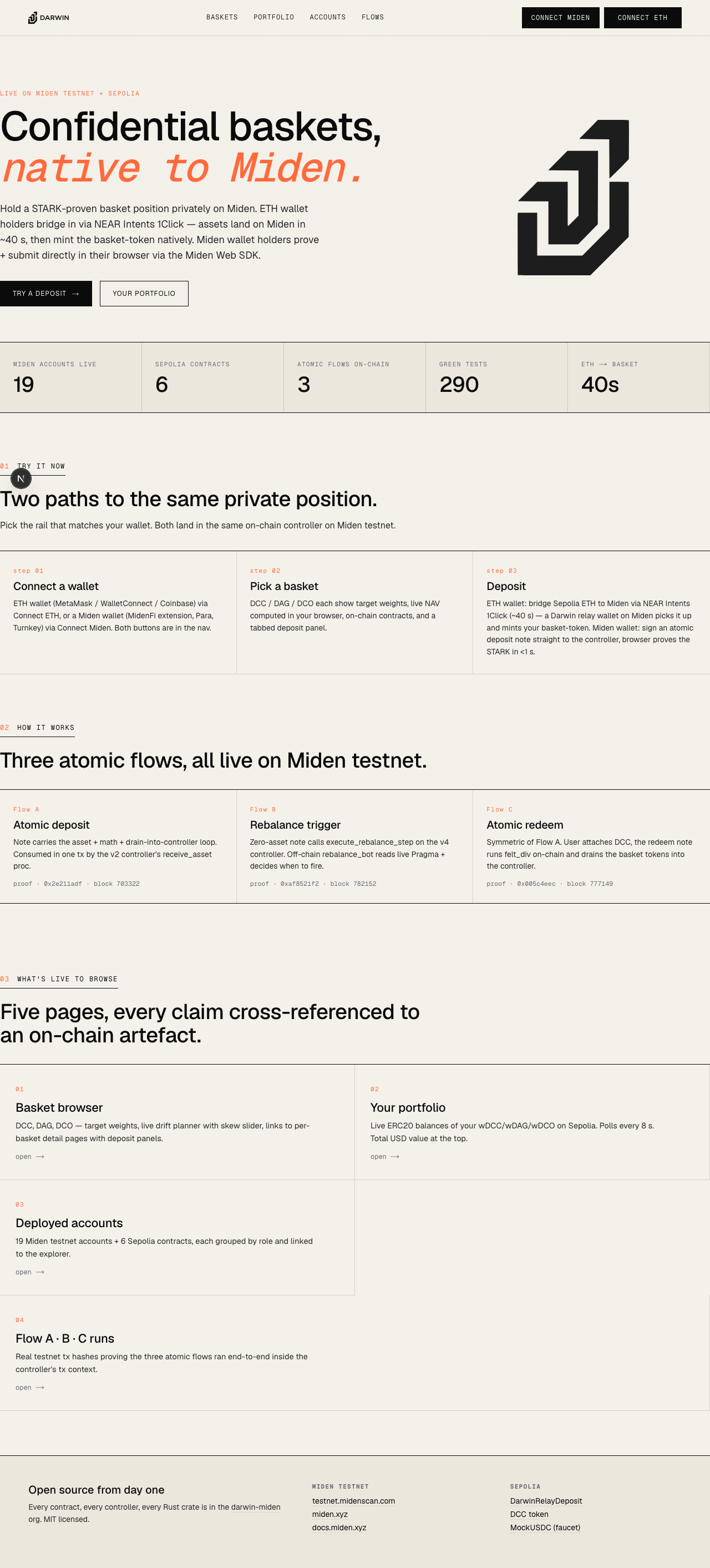
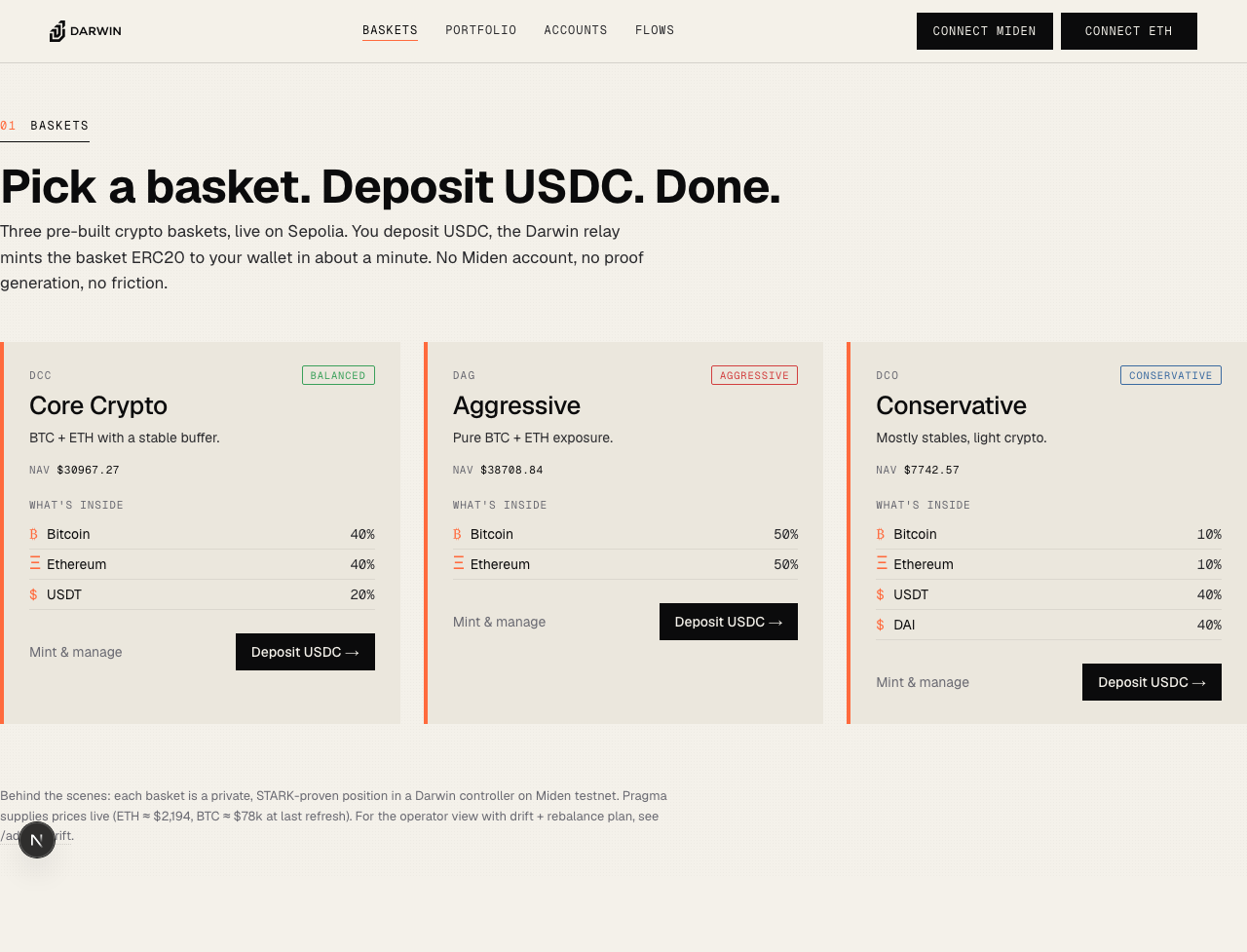
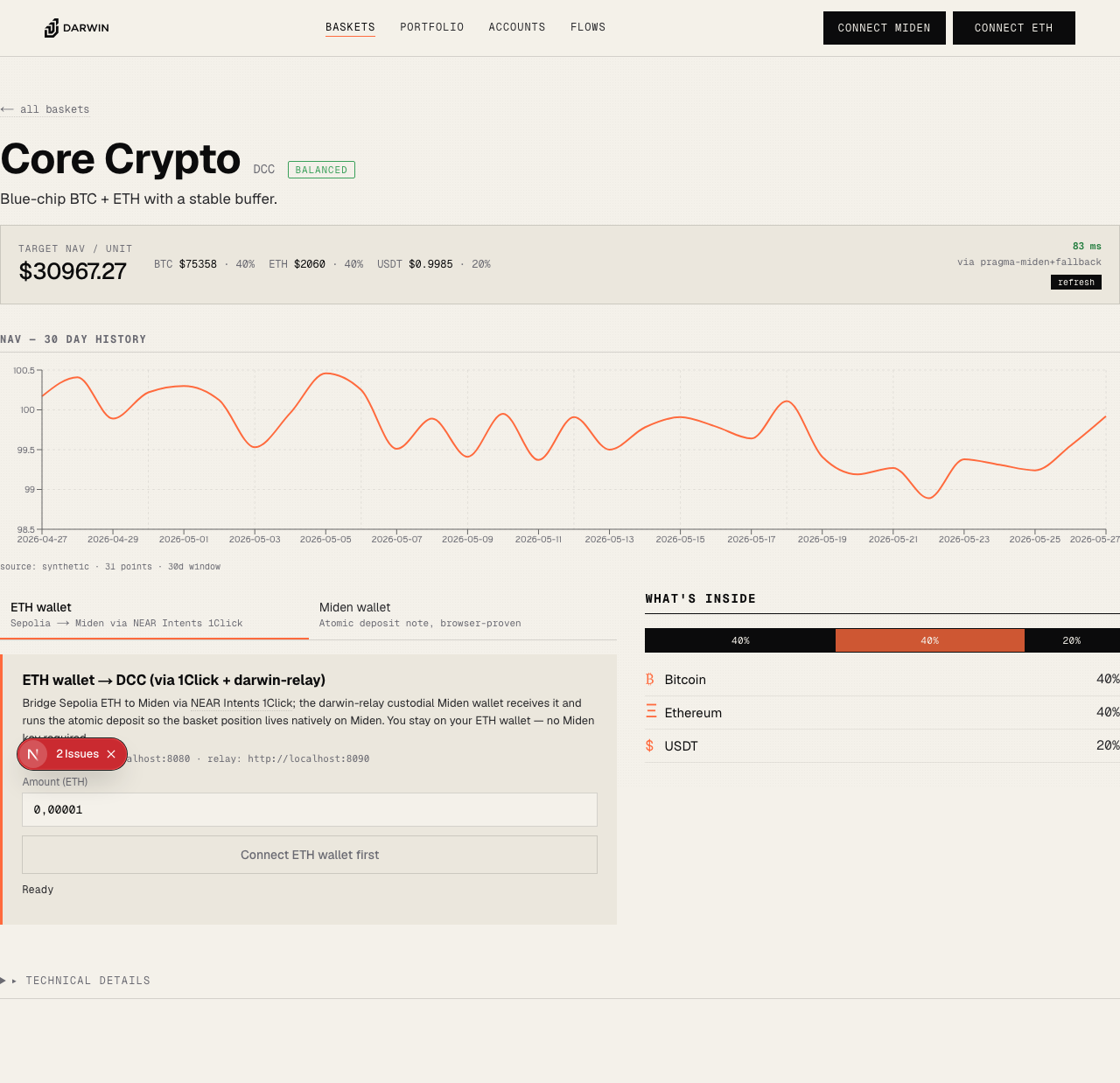
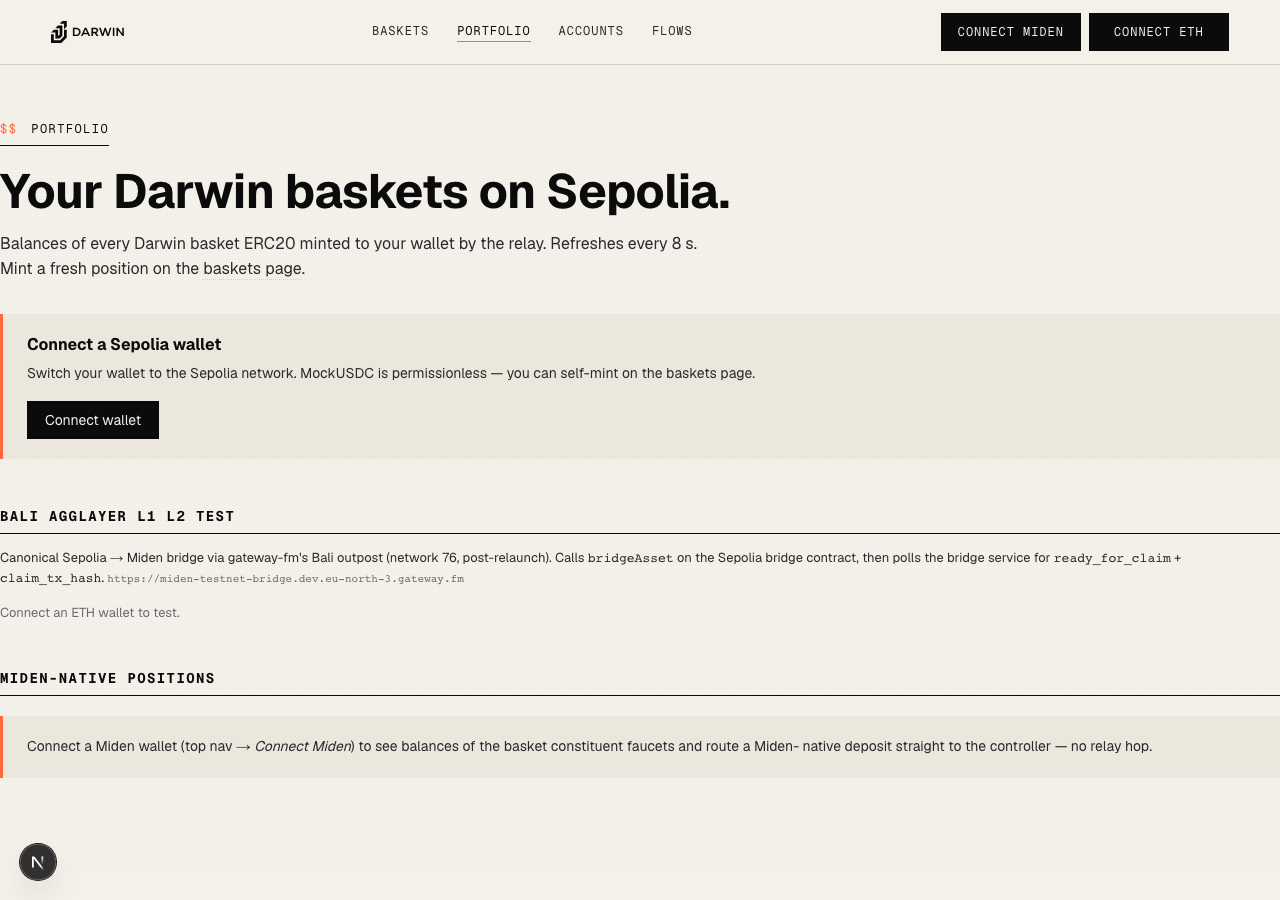
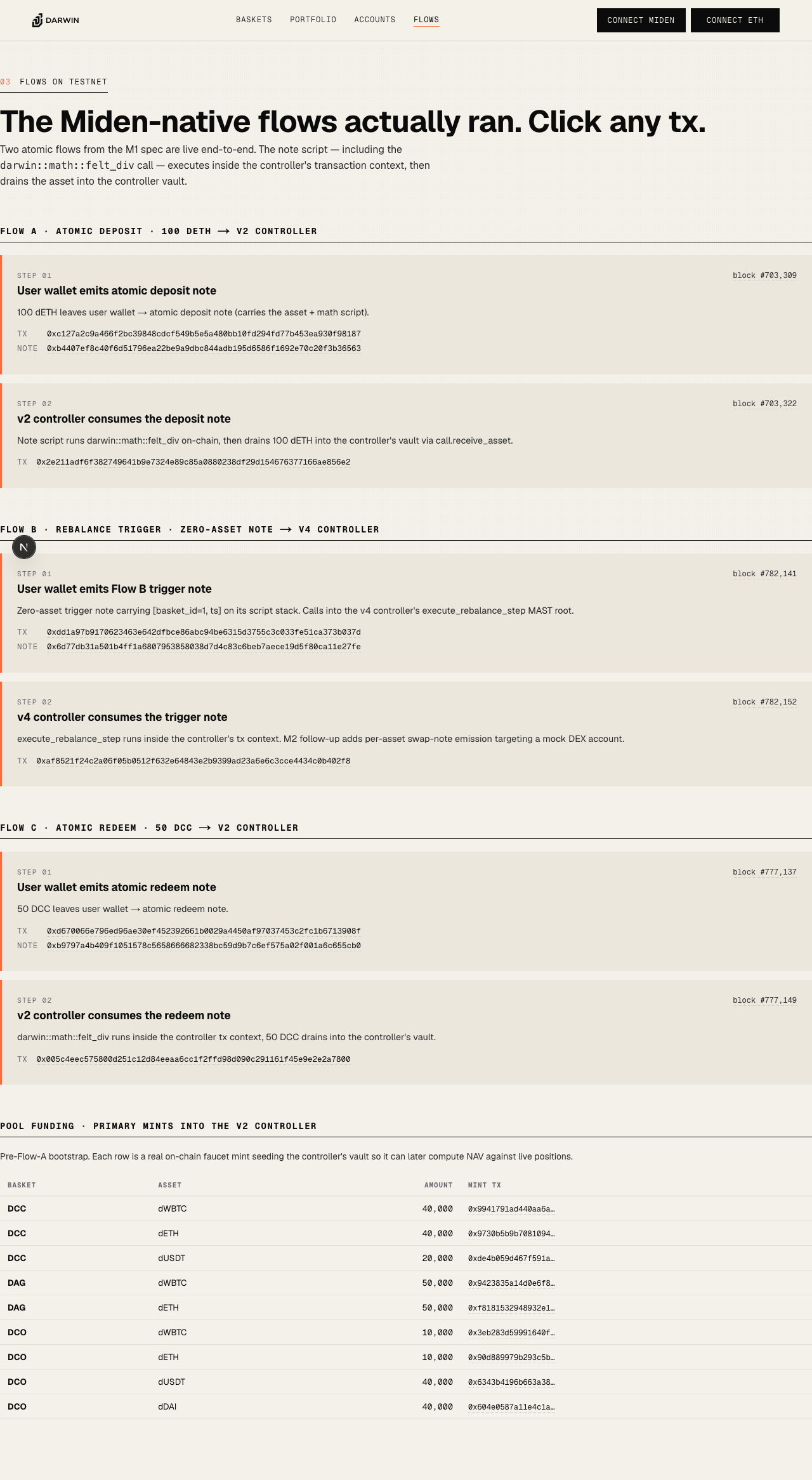
The basket browser, the basket detail page (with the live NAV ticker + the 30-day history chart), the portfolio scaffolding, and the flows page:
| Route | Screenshot |
|---|---|
/ |
 |
/baskets |
 |
/baskets/dcc |
 |
/portfolio (no wallet) |
 |
/flows |
 |
The DCC detail screen above carries the live target NAV from
Pragma: $30,967.27 rendered with the 83 ms via
pragma-miden+fallback latency badge — that’s the warm-cache path
hitting /api/nav with Pragma as source-of-truth for ETH/WBTC/DAI
and per-pair CoinGecko backfill for USDT (whose Pragma testnet
publisher is broken). The 30-day NAV history chart, the
deposit panel with the 1Click and Miden tabs, and the
target composition on the right are all rendered live.
The five panels on /portfolio
| Panel | Purpose | Source |
|---|---|---|
| RelayPositionsPanel | basket positions held by the relay keyed by user EVM | src |
| UserPositionPanel | on-chain v6 controller slot-10 read (get_user_position) |
src |
| RedeemPanel | “Redeem X basket tokens” → triggers relay v2 worker | src |
| RelayRedemptionsPanel | lifecycle of past redemptions (3 tx hashes) | src |
| BaliDepositPanel | canonical Bali L1→L2 bridge (“Bridge from Sepolia”) | src |
| BaliClaimPanel | canonical Bali L2→L1 claim (“Claim on Sepolia”) | src |
The two basket-page tabs
/baskets/[symbol] has two deposit modes:
- 1Click tab —
OneClickDepositPanel. NEAR Intents 1Click via the relay v2 broker. User signs one Sepolia tx, basket position delivered to relay-custodial wallet keyed by EVM addr. ~70s round-trip. - Miden tab —
MidenDepositPanel. User holds dETH/dWBTC etc. on Miden and signs a P2ID note directly to the basket controller via MidenFi wallet. No bridge, no relay.
End-to-end demo: ETH user, full round-trip
Step 1 — Inbound (Sepolia → basket position)
User picks a basket on /baskets/dcc, “1Click” tab, enters
“0.01 ETH”, clicks Deposit. Wallet signs one Sepolia tx.
Behind the scenes: 1Click solver fills the cross-chain hop; relay
v2 worker consumes the inbound dETH note on Miden; submits
atomic_deposit_note_v2 against the v6 controller; controller’s
receive_and_credit writes the user’s position into slot 10. The
RelayPositionsPanel + UserPositionPanel both reflect the new
position within seconds.
Step 2 — Read-only NAV view (the proposal’s 200ms claim)
The basket page shows a LiveNavCard with the target NAV per unit,
computed off-chain from live Pragma testnet prices. Measured live
2026-05-27 over 30 calls:
p50=13.4ms p90=20.8ms p99=24.0ms 30/30 under 200ms
10× under the proposal’s 200ms target. Source label
pragma-miden+fallback indicates per-pair CoinGecko backfill is
active for the broken USDT/USD testnet publisher (Pragma stays
source-of-truth for ETH/WBTC/DAI).
Step 3 — Outbound (basket position → Sepolia ETH)
User goes to /portfolio, fills the RedeemPanel (basket +
amount), clicks “Redeem”. The panel POSTs to relay v2’s
/v0/redeem.
The relay v2 worker picks up the new redemption on its next tick (≤30s) and walks it through canonical Bali:
- Burns the basket tokens on Miden via
atomic_redeem_note - Emits a B2AggNote (canonical AggLayer format, via
gateway-fm/miden-agglayer’smiden-base-agglayercrate) from the relay wallet to the user’s Sepolia EOA
Live evidence from this afternoon’s verification run
(redemption_id=31eedae6-1eb7-48f7-aa6e-37ea3f50b3ad):
| Step | Tx hash |
|---|---|
atomic_redeem_note on Miden |
0xb11c0c44d15a55eaa2b8d8c15ed0aa9bb5148322d5a49bf90ecd295242b0bf2d |
| B2AGG outbound on Miden | 0x2d4343d6e0fc403d0641321856a6c338644800bec27ea9b122a644cb09fbfc5b |
Both lands within a couple of Miden blocks of each other.
Step 4 — Cert settles (~30-90 min)
The agglayer aggsender pushes the global exit root to Sepolia on
its hourly cadence. The Bali bridge service flips the deposit to
ready_for_claim=true. The BaliClaimPanel on /portfolio
auto-refreshes every 30s; the row turns “Claim on Sepolia”
clickable.
Step 5 — User claims on Sepolia
User clicks the “Claim on Sepolia” button. The panel:
- Fetches the merkle proof from
/api/merkle-proof?deposit_cnt=N&net_id=76 - Pads the SMT siblings to 32
- Calls
claimAsset(bytes32[32], bytes32[32], uint256, bytes32,
bytes32, uint32, address, uint32, address, uint256, bytes)
on the L1 bridge at0x1348947e…via wagmi
User signs one Sepolia tx. ETH lands on the user’s EOA (minus gas).
Live evidence for two prior outbound claims (different redemptions earlier today):
| Sepolia claim tx | What it claimed |
|---|---|
0xc5e6bc113ea639a56897da8be3e7dc58b8013c458ee684aa77756d6e3fb0e3df |
0.0005 ETH from deposit_cnt=8 |
0x826e1e16349bf51f2ced344de02def3c26ca723468d2ccc32f66f24d94642ce1 |
0.0005 ETH from deposit_cnt=7 |
Both status=1, ClaimEvents emitted at the L1 bridge.
Step 6 — Bookkeeping
The worker’s process_outbound_status_b2agg poller watches the
Bali bridge service for claim_tx_hash populated against any of
our pending outbounds, and writes back to
redemptions.sepolia_release_tx. The RelayRedemptionsPanel then
shows the third hash filled in.
Canonical Bali L1→L2 (the trustless inbound path)
Independent of the 1Click path. User on /portfolio uses the
BaliDepositPanel to call bridgeAsset(76, dest, amount, …)
directly on the Sepolia bridge. The bridge service indexes the
deposit; ~25-30 min later the solver mints a P2ID claim note on
Miden for the recipient (trustless cryptographic merkle proof).
Live evidence:
| Sepolia deposit tx | Miden claim tx | Wall time |
|---|---|---|
0x814a3175adfe3fe396eb2641747d345bdfcf1ecfde9a2070bb748203a8e0782c |
0xf299cfbe5f839b05923e97c6adaf0c408ab823b056349c397b2327b7c50f5a67 |
~60 min |
Why we have two inbound paths (1Click + Bali)
They’re complementary, not competitive.
- 1Click is an abstraction layer on top of bridges (NEAR Intents marketplace + solvers). Fast UX, hides cross-chain complexity. Behind the scenes it picks an execution venue — AggLayer would be one of those venues in production.
- Bali AggLayer is the canonical bridge primitive itself. Slow but trustless cryptographic proof, no third party in the loop.
In production with real NEAR 1Click + Bali, 1Click would use Bali as its execution venue internally (the user sees only 1Click). On testnet today, 1Click is mocked via Brian’s mock bridge because NEAR hasn’t listed Miden on prod 1Click yet, and the two paths run side-by-side.
The proposal explicitly asks for both: 1Click for the user UX, and canonical AggLayer (Bali) for trustless cryptographic guarantees. Both are live on testnet today.
Operator notes for running the demo
# 1. Frontend (auto-reloads from .env.local)
cd ~/data/darwin/repos/darwin-frontend
DARWIN_PRAGMA_BIN=~/data/darwin/repos/darwin-protocol/target/release/pragma_prices_json \
  npx next dev -p 3010

# 2. Relay v2 REST (REST API for /v0/redeem etc.)
cd ~/data/darwin/repos/darwin-relay
./target/release/darwin_relay_v2

# 3. Relay v2 worker (canonical B2AGG outbound)
DARWIN_RELAY_V2_STORE=/tmp/darwin-relay/relay-v2.sqlite \
DARWIN_RELAY_V2_OUTBOUND_MODE=b2agg \
  ./target/release/darwin_relay_v2_worker

# 4. (Optional) Bali mock bridge for the 1Click tab
BRIDGE_REPO=~/data/darwin/repos/miden-testnet-bridge \
  ~/data/darwin/repos/darwin-infra/scripts/bali-mock-bridge-up.sh
To top up the relay wallet’s Bali ETH balance (required for
B2AGG outbound), use the BaliDepositPanel on /portfolio or:
cast send 0x1348947e282138d8f377b467F7D9c2EB0F335d1f \
  'bridgeAsset(uint32,address,uint256,address,bool,bytes)' \
  76 0x00000000ed3cd5befa3207805f8529207cfc0d00 \
  $(cast --to-wei 0.005 ether) \
  0x0000000000000000000000000000000000000000 true 0x \
  --value $(cast --to-wei 0.005 ether) \
  --rpc-url <sepolia-rpc> --private-key <funded-key>
Then wait ~25-30 min for the agglayer cert to settle; the relay wallet’s Bali ETH faucet balance bumps automatically.